A Look Back at 2022
Nothing Found
It seems we can't find what you're looking for. Perhaps searching can help.

Highlight

Nationwide
Access to healthy food is well documented to reduce people's risk of chronic health conditions and contribute to better health and well-being. While the Supplemental Nutrition Assistance Program (SNAP) aims to alleviate food insecurity, the primary focus of the Double Up Food Bucks nutrition incentive program has always been ensuring that children and families not only have access to enough food, but the vital nutrients that are the foundation of a healthy, active life and healthy communities.
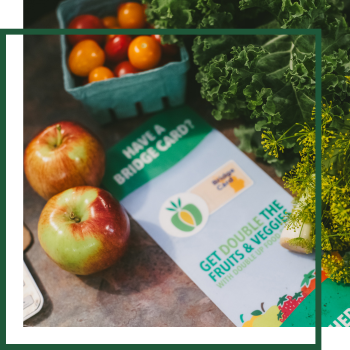 Double Up Food Bucks was launched at five Detroit-area farmers markets in 2009 and has since become a model for nutrition incentive programs across the US. Nutrition incentive programs like Double Up Food Bucks are designed to improve overall individual and community health by incentivizing the purchase and consumption of fruits and vegetables by consumers participating in the SNAP program. Similarly, produce prescriptions are a nutrition incentive that increases household food security while reducing healthcare usage and associated costs. “Rather than stigmatize or limit what food people can access, nutrition incentive programs help people choose the healthy foods they want to eat, while also stimulating the local economy,” says Holly Parker, Chief Strategy and Program Officer at Fair Food Network.
To ensure that nutrition incentives are available across the US, Fair Food Network supports produce prescription and nutrition incentive projects as a partner Nutrition Incentive Hub alongside University of California San Francisco and led by Center for Nutrition & Health Impact. The partnership supports training, technical assistance, reporting, and evaluation to strengthen programs all across the country.
In addition to providing technical assistance, Fair Food Network aims to amplify a unified voice in support of nutrition incentive programs and a strong SNAP program. As part of these efforts, the organization actively advocates for the continuation of federal funding for produce prescription and nutrition incentive programs like Double Up Food Bucks. In the past year, Fair Food Network coordinated advocacy efforts supporting the advancement of nutrition incentive programs, working with legislators and their staffs to educate them on the importance of nutrition incentives in providing families nutrient-dense fruits and vegetables.
One notable aspect of practitioners that implement nutrition incentive programs is their ability to innovate and adapt programming to local needs. In our national policy and technical assistance efforts, we’ve had the privilege to work with, support, and learn from organizations all across the country. “Nutrition incentive programs have successfully adapted to serve the unique needs of their communities and can vary a great deal regionally and culturally,” added Parker. Fair Food Network has adapted technical assistance and capacity building offerings through the Nutrition Incentive Hub to be responsive to these varying needs.
In remote locations such as Bethel, Alaska, for instance, the Bethel Community Services Foundation (BCSF) is leveraging a capacity building grant from the Nutrition Incentive Hub to begin testing shipping materials used to send produce to small villages in Alaska. BCSF serves the largely Yup’ik community of Bethel and the surrounding subarctic region, dotted with remote settlements not easily accessible except by plane. With just over 6,000 inhabitants, Bethel is the largest population center in western Alaska. The Community Center is responsible for, among many other things, running the produce prescription program that serves the area. Their goal is to improve the quality and increase the quantity of fresh produce shipped to participants who have limited fresh options in their local stores.
“Produce prescriptions allow health care providers to prescribe fresh fruits and vegetables to patients, just like they’d prescribe medication,” says Parker. To be effective in addressing diet-related conditions like diabetes, heart disease, and obesity, participants need consistent access to the healthy foods the program provides. The ability for BCSF to customize its program to reach Alaska’s far-flung rural communities is an advantage of the flexible nature of nutrition incentive programs and the capacity building grants that make local innovations possible. And those advantages ripple throughout the nutrition incentive field when programs test innovations that can be scaled to support community resilience elsewhere. “Innovations like BCSF’s program help them reach particularly vulnerable populations while serving as models for what programs in remote areas can do,” said Parker.
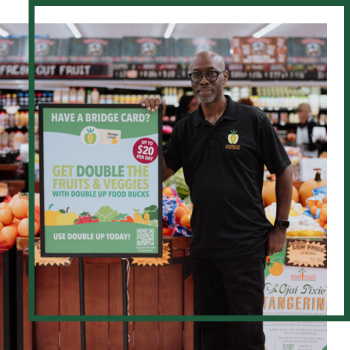 Fair Food Network’s own Double Up Michigan team aims to help families bring home healthy fruits and vegetables while supporting Michigan farmers, in this case by working with grocers and food distribution networks to create more connections between what’s being grown locally and what’s available on store shelves. “Independent stores want to offer more fresh, local options, but they often don’t have the infrastructure, sourcing connections, or volume needed to access Michigan-grown produce consistently,” says Charles Walker, retail specialist. “They need support to bridge that gap—so they can be part of the solution in bringing healthy food closer to home.” Double Up Michigan aims to ensure the nearly 30 food retail locations in the city buy 20% or more locally grown produce during peak growing season in Michigan as a key requirement of being a part of the program. This helps build the market for Michigan farmers by driving demand for locally grown fruits and vegetables as part of the program model. Double Up Food Bucks in Michigan not only helps people using SNAP benefits but also supports farmer viability and keeps dollars circulating in local economies.
“Nutrition incentive programs, including produce prescriptions, have proven to be very flexible in meeting local needs,” says Fair Food Network’s Parker. “That’s one of the reasons they’re so effective, and the main reason we’re seeing these programs gain traction all across the country.”
The popularity of nutrition incentive programs like Double Up does not, however, guarantee their future success. More work is needed to ensure the impact of these programs continues. “Nutrition incentive and produce prescription programs have become part of the fabric of their communities, and these programs are absolutely dependent on federal funding,” says Alex Canepa, Policy Director at Fair Food Network. It will be essential in the coming year to work with the USDA and policymakers to ensure that nutrition incentives — supported by Republicans, Democrats, farmers, and families — are faithfully implemented in communities across the country. “What we know, and what participants in nutrition incentive programs know,” says Canepa, “is that there’s power in choosing the foods your family eats.”
Highlight

Michigan
Since its launch over a decade ago in Flint, the Double Up Food Bucks program has been so popular that the city has become a centerpiece for program innovations. In 2014, in response to the Water Crisis, Fair Food Network expanded the foods eligible for earning Double Up in Flint, helping families bring home even more healthy food. Flint hosted our Cashier Engagement Pilot and introduced innovations to the point-of-sale system that are now used to seamlessly process Double Up transactions in locations across Michigan.
But despite Double Up’s historic impact in the city and its consistent presence as a community resource for more than a decade, Double Up usage in Flint — unlike in every other community where the program is available in Michigan — has declined in recent years. That means that at a time when Fair Food Network was making a concerted effort to increase program usage and reach more participants, Flint participants were using Double Up less.
In 2023, we launched a new community engagement strategy focused on gaining insight into this anomaly and seeking to learn more about how people were using Double Up in Flint. What we discovered from our conversations provided a lesson in the necessity of establishing and maintaining trust with program participants and making program adjustments informed by the unique needs of each community where we work. Leveraging our deep connection to the city of Flint, we spoke with local retailers, farmers, families, and evolve Double Up to meet Flint shoppers where they’re at.
Our Double Up team hosted a series of in-person events in 2023 to raise awareness, increase our presence in the community, and rebuild trust in the program. In addition, we expanded the visibility of the program by showing up more frequently in more places, including participating in promotions hosted by Women, Infants, & Children (WIC) and partnerships with Hurley Medical Center's Food FARMacy, Flint Fresh Mobile Market, and the Crim Fitness Foundation. Program marketing materials better reflected the unique experience of Flint Double Up participants, with video and photography highlighting local shoppers, imagery, and stories; a radio ad featuring a local mother and son; and a “How Do You Double Up?” video sharing the unique ways Flint shoppers can use the program.
Feedback from shoppers and program staff also helped us to better reach Flint residents who use SNAP. To ensure shoppers had a positive experience with the program, we intensified our Double Up site visits and ran more cashier engagement events. Relaunching Double Up at a critical location where the program had recently been discontinued proved to be a boon to the surrounding neighborhood. And we put more targeted advertising in places frequented by SNAP shoppers, like buses and bus terminals. “A lot of shoppers rely on the bus system to get to and from Double Up locations,” said Program Ambassador Aaron Neeley. “The main bus terminal is right across from the Flint Farmers Market. So, the bus ads and radio ads were very effective and reached a lot of Double Up customers.”
In addition to ramping up outreach activities, we evolved the program to meet Flint participants’ specific needs, relying on feedback from farmers, retailers, and shoppers to guide how Double Up works in the city. Again and again, we heard from program participants that the $10/day earning limit — temporarily reduced from $20/day in response to overwhelming demand during the pandemic — was forcing Flint families to make some difficult choices. While our team was in town to attend Rep. Dan Kildee’s press conference on the farm bill, we observed one family returning fruit to the shelf so they could stay within their Double Up budget. Said one Flint shopper: “I rely on Double Up Food Bucks. The limit change really hurt me.”
Flint families spoke and we listened: In fall of 2023, upon receiving an essential infusion of funding for Double Up from both state and federal sources, Fair Food Network raised the daily earning limit to its previous maximum of $20. The return to the familiar daily earning limit, said Associate Director of Double Up Food Bucks Michigan, Cassidy Strome, was a significant factor in turning around the yearslong decline in Double Up usage in Flint, contributing to a 49 percent increase in program usage since September 2023.
In 2024, we continue to work to keep Flint program usage high. Lessons learned over the past three years in Flint have reinforced the importance of showing up in person more often; strengthening our connections and building new ones; working alongside community partners to turn feedback into action; and raisings the visibility of a program that will continue to play an outsized role in the lives of Flint families. To Flint Farmers Market Manager, Karianne Martus, it’s hard to overstate the impact that Double Up Food Bucks has had — and will continue to have — in Flint: “I truly cannot imagine our market or our community without it.”
Highlight
Michigan
With strawberries ubiquitous on supermarket shelves even in January, we tend to think of warm-weather states providing America’s fruit and vegetable bounty. A little-known fact is that Michigan, even with its northerly latitude and long winters, has the second most diverse agricultural output in the United States, offering more than 300 different commodities from more than 50,000 farms dotting the landscape from Detroit to the Upper Peninsula.
Our Fair Food Fund bolsters local food systems by supporting Michigan farmers in getting their produce to market, creating networks and partnerships that strengthen the needed infrastructure connecting communities to farmers and the abundance grown all around them. Fair Food Fund’s financing and technical assistance allowed two such enterprises, Great Lakes Farm to Freezer and Lakeshore Depot, the opportunity to bring more locally grown food to the communities where they live and beyond.
Great Lakes Farm to Freezer is a West Michigan processor distributing frozen produce exclusively sourced from Michigan farms to institutions, businesses, and families. Great Lakes Farm to Freezer’s commitment to supporting local agriculture includes offering local growers two and three times what other processors pay. A Fair Food Fund loan enabled the company to equip and outfit a new facility in Caledonia, Mich. that will support increased capacity for in-house production and enhance Great Lakes Farm to Freezer’s potential for expansion throughout the Great Lakes region.
Farther north, in the largely rural Upper Peninsula community of Marquette, Mich., Lakeshore Depot serves as a “farm stop” (a hybrid grocery store/farmers market) that exclusively features local and regional foods and seasonal, fresh produce. Lakeshore Depot currently sources from 48 local farmers — who receive 75% of the sale of their produce — and an additional 38 local food vendors. Fair Food Fund’s microloan in 2023 helped to prepare Lakeshore Depot for future financing that will support their long-term growth plan, including hiring a full-time manager and increasing product selection.
Even as these businesses broaden their offerings and expand their reach, they remain committed to their communities. Said Lakeshore Depot founder and owner, Mike Hainstock: “I wanted the store to have an impact felt throughout our local community, one that our community as a whole is excited about and carries real and positive change moving into the future.”
Highlight
Michigan
Americans throw away more food than any other country, with nearly 92 billion pounds of food — or more than one-third of the U.S. food supply — rotting in landfills annually. This represents not only the loss of nutritious food that could have helped to feed families, but has environmental consequences in the wasted land, water, labor, and energy used to produce it. And as that waste decomposes, it produces harmful greenhouse gases. All told, it is estimated that the production of food that is eventually left to decompose in a landfill creates the equivalent greenhouse emissions of 37 million cars.
Through the work of our Fair Food Fund, we recognize the opportunity to increase the social and environmental impact of our work by supporting waste reduction businesses whose sustainable practices support resilient agriculture by diverting and upcycling food waste.
Located outside of Grand Rapids, Mich., Wormies is a vermicomposting (worm compost) business that helps local residents, restaurants and food product makers reduce their waste by upcycling food scraps into premium compost for sale to local producers and farmers. “Worms’ life purpose is to break down organic matter and make an all-natural fertilizer for plants,” says Wormies founder, Luis Chen. “Worms are turning waste into a resource of the highest value.”
Our Fair Food Fund provided Wormies with a line of credit to meet the match requirement on a grant from the Michigan Department of Environment, Great Lakes, and Energy. The grant has allowed Wormies to expand its processing capacity from 60 to 200 cubic yards of food waste per month and increase its daily clientele from 610 to 2,000 households and businesses. “Composting prevents landfills from polluting the land and the waterways and the air we breathe,” says Chen. “Our community has a great opportunity to significantly reduce landfill contamination.”
We aim to make more investments in businesses like Wormies that are generating win-wins: advancing positive change in the food system and providing continuous benefits to their community and beyond.
Highlight
Michigan
With the cost of many grocery items hovering at historic highs, more and more Americans simply don’t have enough to eat. Without assistance, they don’t know where their next meal is coming from. The need for the Supplemental Nutrition Assistance Program (SNAP, formerly known as food stamps) has never been greater, with more than 40 million Americans relying on the program to put food on the table. And yet, even with SNAP, healthy and nutritious food is often out of reach for families with low household incomes.
Some of the most vulnerable consumers are forced to make daily decisions between buying healthy and affordable food. For Michiganders, that’s where programs like Double Up Food Bucks can help. Participants in SNAP are automatically eligible to use the Double Up program at one of its 234 participating farmers market and grocery store locations. Double Up incentivizes the purchase of healthy food by matching, dollar for dollar, SNAP purchases of fresh fruits and vegetables, up to $20 per day. As one Michigan shopper put it, Double Up is the difference between eating fruits and vegetables and going without. “I couldn’t afford [fresh fruits and vegetables] without the program,” she said. “I wouldn’t be able to try to help my grandmother...and maintain her where we’re at. It’s just me trying to hold things together as much as possible,” she said. “Double Up Food Bucks has helped.”
For many Michiganders, the program is essential. And it’s not only consumers who benefit. All Double Up purchases at farmers markets support local agriculture. And during peak growing season, participating grocery stores stock more locally grown fruits and vegetables in their produce sections. Said one Michigan farmer: “It’s a program that supports small-scale Michigan vegetable growers while also increasing access to fresh, healthy foods for low-income folks — a win-win.”
As farmers markets and Double Up grocers experience the benefits of increased purchases of local produce, the economic benefits ripple outward into communities, making the program a triple win. “We’re able to get assistance and then we’re putting it right back into our community and back to the farmers near our home, and so they’re able to get assistance,” said one SNAP shopper. “It makes for a more thriving market, a more thriving community, socially and economically.”
“Trying to eat healthy, local foods costs hundreds of dollars a month no matter where I shop,” added another. “Not having to worry about this takes so much of the burden off of my plate because otherwise, I would be spending about [as] much as my rent on food, and after that cost I wouldn't normally have much money left over.”
The Double Up program has weathered especially challenging times recently, such as the COVID-19 pandemic, even while helping to mitigate some of the effects of the crisis and take on persistent high inflation that has disproportionately hit food prices. Yet food insecurity predates the coronavirus and inflation, and presents a growing problem in the U.S. Double Up remains an essential community resource no matter what’s happening in the world around us. “We definitely saw a spike in usage during the pandemic — and a lot of new folks,” said Cassidy Strome, Associate Director of Double Up Food Bucks Michigan at Fair Food Network. “And still, even post-pandemic, we’re seeing elevated participation in the Double Up program.”
“People really appreciate — and rely on — Double Up Food Bucks,” she added.
Fair Food Network’s Double Up Food Bucks is a nutrition incentive program that aims to increase fruit and vegetable purchasing among people who use SNAP as part of their monthly food budget. The program is funded by the Gus Schumacher Nutrition Incentive Program (GusNIP), a grant program administered by the United States Department of Agriculture (USDA) with funds appropriated by the 2018 Farm Bill. The Michigan Department of Agriculture and Rural Development (MDARD) is firmly committed to creating marketing opportunities for Michigan fruit and vegetable growers and provides some of the matching funding for Double Up in Michigan.

It seems we can't find what you're looking for. Perhaps searching can help.